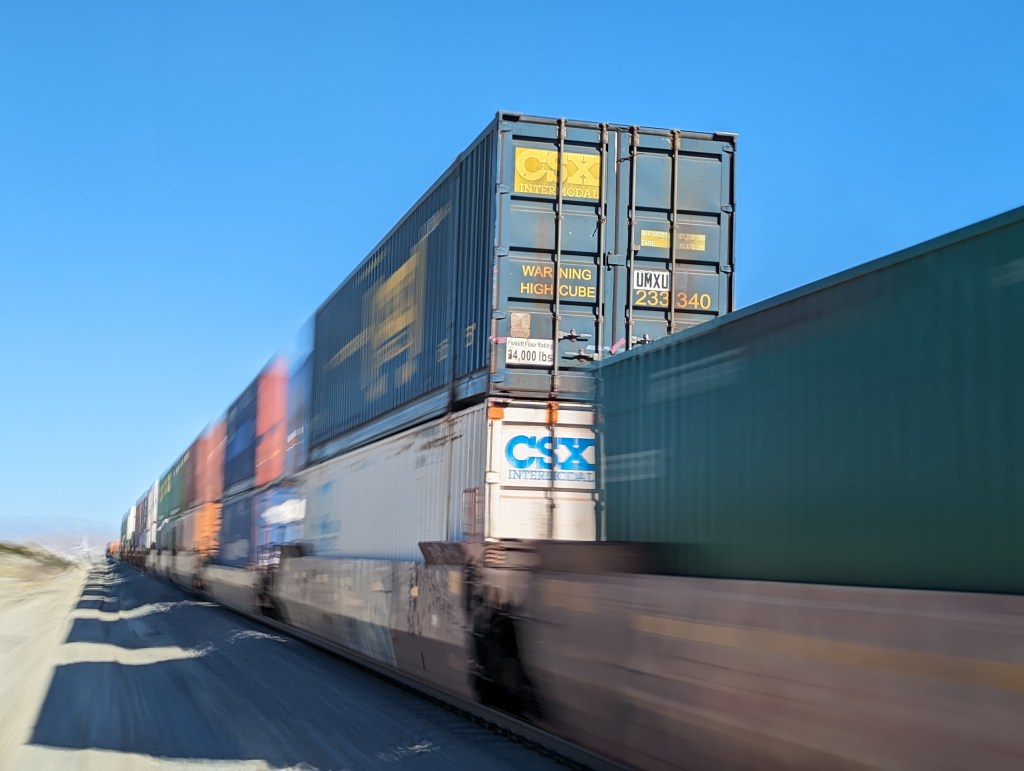
Trains are different in America. Like so many other things (people, portion sizes, cars, ambition), they’re bigger here than they were in Europe. The part of the United States where I live and that I’m most familiar with, which is California and the western states, the most frequently encountered kind is the freight train: A mile long, pulled by multiple diesel engines, slowly making its way through deserts, plains and narrow mountain valleys. Its size, the steel-on-steel squeals it makes, the obvious power of its engines and the solidity of the cars makes the boy inside me jump up and down.
In Europe, the most commonly encountered trains are carrying passengers. They’re electrified, often consist of just three or five cars, are painted in bright colors and move fast. Their interiors are designed and feel the same than airplane cabins. They’re utilitarian, have surfaces made of plastic and fabric, every inch is used, and the overall impression is bland but not unpleasant.
In the American West, outside of the metropolitan areas, passenger trains are rare. One example is the California Zephyr traveling 2,438 miles between Chicago and San Francisco. One of its stops is the town of Truckee in the Sierra Nevada at 5,817 feet altitude, where I encountered it one night leaving a bar with my wife. The town is arranged so that the restaurants and bars on main street are facing the railroad tracks. The side of the tracks were dark, with the only light coming from the doors on the side of the train cars that had opened to allow the passengers to disembark. The bluish light shining out of the openings of the otherwise dark train reminded me 1980s science fiction movies, where the same kind of light shines from the openings of alien spacecraft. Some of the passengers had taken the opportunity to explore the town without venturing too far from the waiting train, and we started talking to man who had come all the way to Omaha. Listening to him, and looking at the dark train behind him, it seemed like a great way to travel, provided than one had the time.
When I grew up in Europe, I was neutral towards railways. They were just another mode of transportation. This has changed. The vast trains moving through the landscapes, with no-one in sight, inspire awe in me of what human engineering is capable of.
 Nehaveigur