Fred Hoyle was an accomplished astronomer but also came up with a few controversial theories that didn’t take off, not that there’s anything wrong with that. For example, he proposed that the archeopteryx fossils are forgeries and that flu pandemics are caused by solar winds driving interstellar virus particles towards Earth during the peak of solar activity. He published this idea together with Chandra Wickramasinghe in Nature in 1990. The graph below is convincing. It shows the number of sunspots each year, following an 11-year period, with pandemics denoted by vertical lines. Based on their data, it appears that all recorded influenza pandemics have occurred close in time to sunspot extremes.
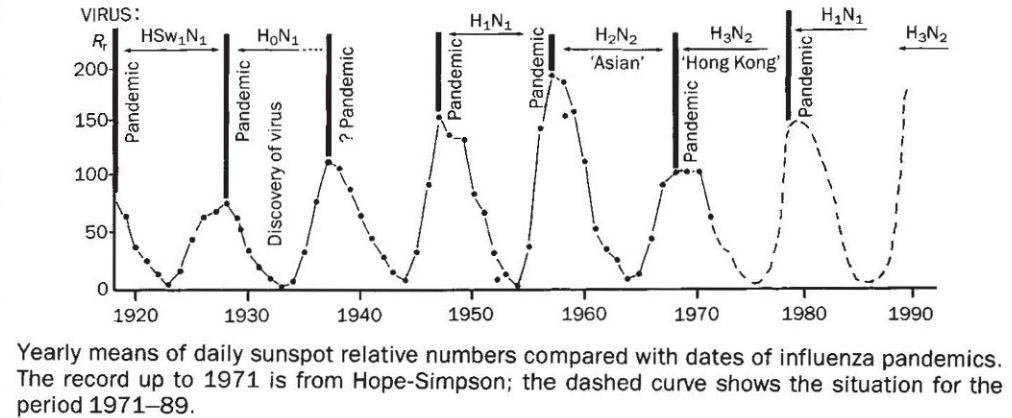
Wickramasinghe has since gone on to claim extraterrestrial origins for most viral pandemics, including for COVID-19. Unfortunately for his theory, the emergence of the coronavirus pandemic in 2019 or it’s peak in 2020 didn’t coincide with peak sunspot activity, which is likely to occur this year. A 2017 paper using a dataset covering a longer timespan and using more sophisticated statistics didn’t find any significant association between solar activity and pandemics. For anyone who doesn’t believe in the extraterrestrial origin of viruses, which is almost everyone, this is not going to be a surprise.

While searching for papers on this topic, I came across a publication from 1993 proposing an association between solar activity and longevity. I didn’t follow up, but I wouldn’t hold my breath that it holds up to scrutiny either.
 Nehaveigur