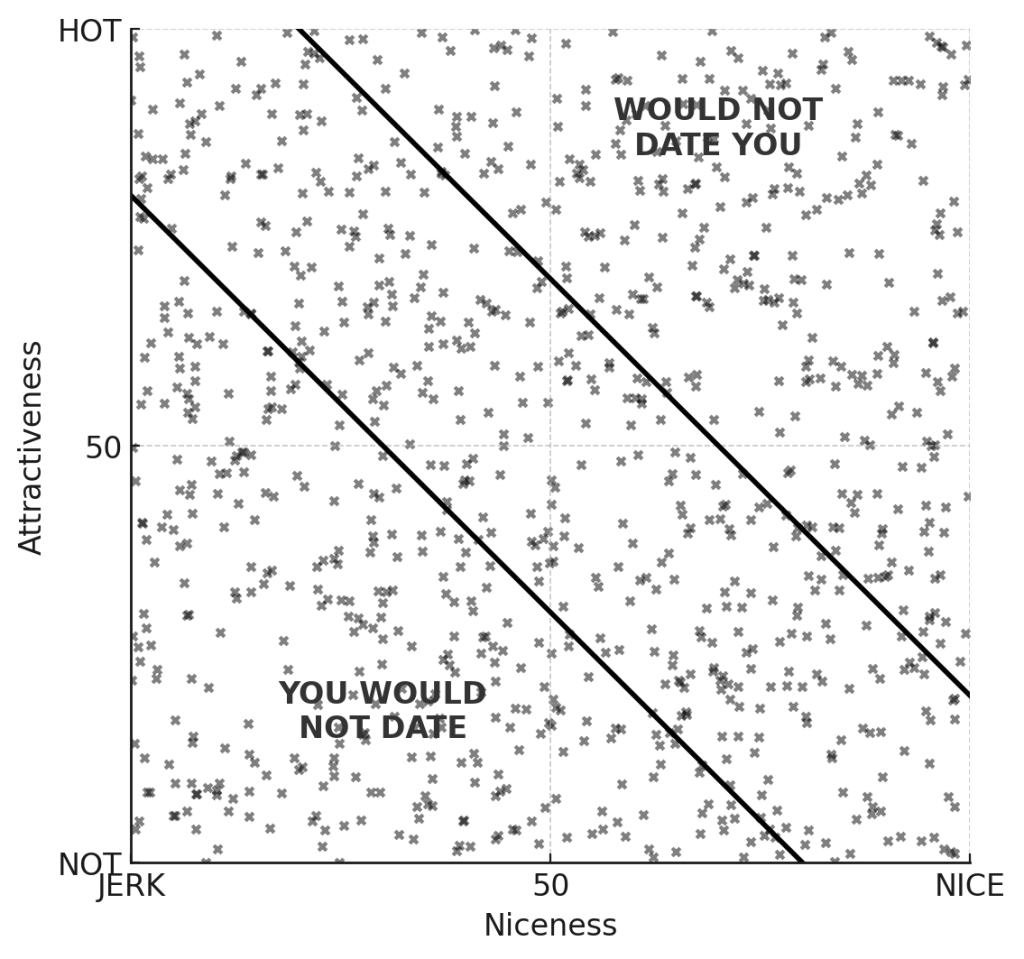
This is also known as Berkson’s paradox. It arises when there is ascertainment bias in the study design.
Here’s an example from Carl T. Bergstrom and Jevin D. West’s book, Calling Bullshit: It seems that when dating there is an inverse correlation between attractiveness and niceness. However, those who are nice and attractive would be less likely to date you since they’re already in a relationship, and one wouldn’t date those who are both unattractive and not nice, leading to a biased sample.
The index event bias is a form of collider bias induced by conditioning on disease status in a clinical study. For example, when measuring the level of a biomarker at a given age and then checking whether it is predictive for time to event (e.g. disease onset), results can be different than expected because those who already have the disease at biomarker measurement will have been removed from the analysis, therefore biasing the results.
This post is part of the Encyclopedia of Concepts.
 Nehaveigur