Why are right wing parties doing well recently? Explanations that are limited to a single country (“It’s a backlash against Biden and Obama“) aren’t satisfying, since the trend persists across most of the Western world. Right-wing parties are also doing well in Europe, including Austria, where I was born and grew up. In addition, it doesn’t explain why right-wing parties are doing well in multiple places at the same time. Countries like Spain and Greece have gone through economically extremely different times in recent memory without voting in the same type of right-wing parties. Similarly, why was there a wave of fascism in the 1930s that affected multiple parts of the world at once?
An alternative explanation is that people have arrived at favoring right-wing policies after having carefully considered the evidence. The neoliberal consensus has failed, and right-wing policies now appear favorable in comparison. There may be some truth in this, but I don’t think it’s fully convincing either since the right wing espouses too many positions that are simply wrong, such as on free trade.
Instead, I believe that being right wing is simply in fashion right now, and that most explanations that point to economic conditions or the failings of other ideologies are largely post-hoc rationalizations.
Another way to think about this is using the concept of Pace Layering, as described by Stewart Brand here. He proposes six levels of pace and size in the working structure of a robust and adaptable civilization. I believe that much of contemporary politics, and probably of all politics, is part of the fashion layer, rather than the governance layer.
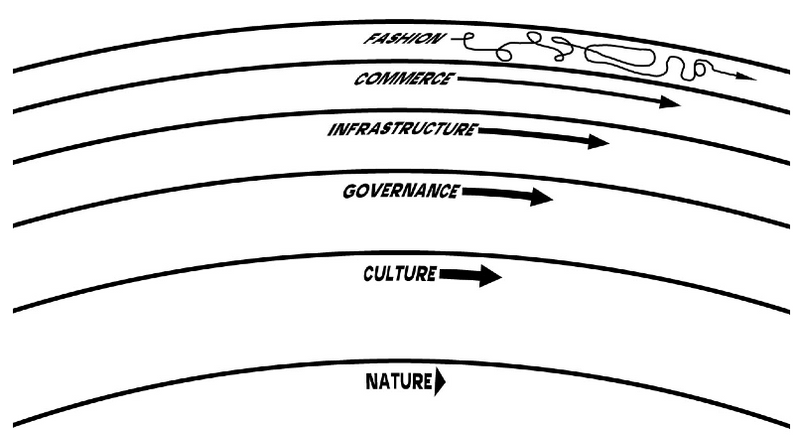
Fashion is shaped top-down rather than bottom-up. It’s typically not something that emerges but it is made by fashion designers. Chris Arnade puts it this way:
I’ve been thinking a lot recently about how cultures change, and my general view is that they are built from the top down, by elites, either explicitly like Napoleon and the CCP in China, or implicitly, without such a direct plan, but still with a desire to mold, shape, and reform society.
Political fashions are made by our political and cultural leaders, and in the West, this starts with our elected politicians. Since political fashions are also global, and since American politicians have particularly high visibility, they also have a large impact on what’s fashionable politically.
One big difference between the fashion we wear and political fashion is its impact, even though fashion designers may want to believe something else.
 Nehaveigur