How much of variance in economic performance is due to a country’s economic policy? This is an important question because our political discourse assumes that economic policies matter a great deal. It’s the economy, stupid. Politicians propose their policies, voters compare them to their rivals’ policies and vote accordingly, and in the next election, we judge the performance of the ruling candidate or party based on how well we feel the economy is doing.
The graph below shows the GDP per capita growth of Austria, the country I’m originally from, and its largest neighbor, Germany.
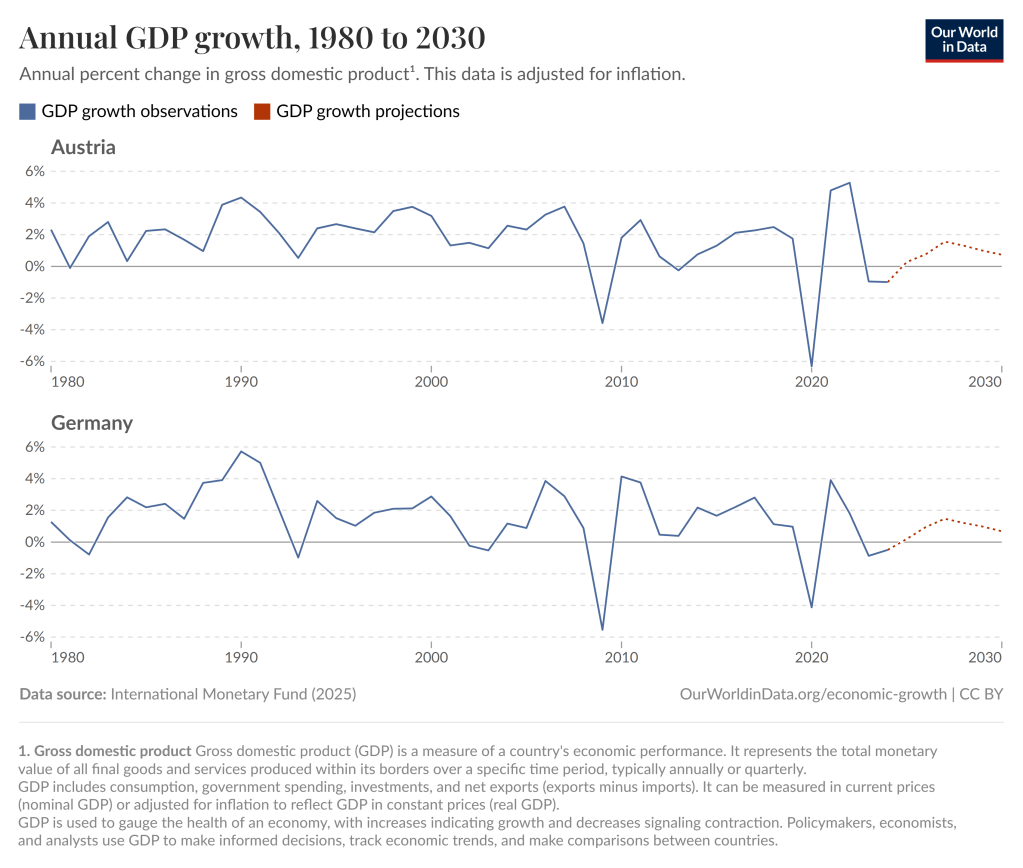
R2 for this time series is 0.62, which means that 62% of the variance in year-to-year GDP growth of Austria is determined by German growth. A model that also included Austria’s other neighbors and the entire world economy would likely result in an even larger proportion of Austria’s growth being determined by external factors.
This shows that most of Austria’s year-to-year economic growth has nothing to do with the decisions of Austrian voters and politicians. Yet like any other democracy, Austrians assume that those choices matter a great deal.
Of course, there are examples of policy choices making a big difference. Mostly the difference is negative, as is the case for Venezuela under President Hugo Chávez and now Nicolás Maduro. The policies of large countries like the United States also have more impact on domestic growth than those of smaller countries like Austria, which in addition is also dependent on the European Union. I’m not aware of any examples of small, developed countries massively outperforming their neighbors in the short run. In the long run, this happens (Ireland and Switzerland for examples), but it’s unlikely that any single economic policy or even any single politician deserves credit.
Still, this way of looking at economic performance is useful for calibrating expectations around the impact of domestic policies, and for assigning appropriate credit and blame for the nation’s economic health. Political discourse would be healthier acknowledging this.
 Nehaveigur