Some ways of thinking about evolution and natural history don’t go away, no matter how forcefully they get refuted.
In my dentist’s waiting room earlier this week, I browsed through the November 2025 edition of National Geographic. The reading material my dentist provides is his biggest redeeming quality.
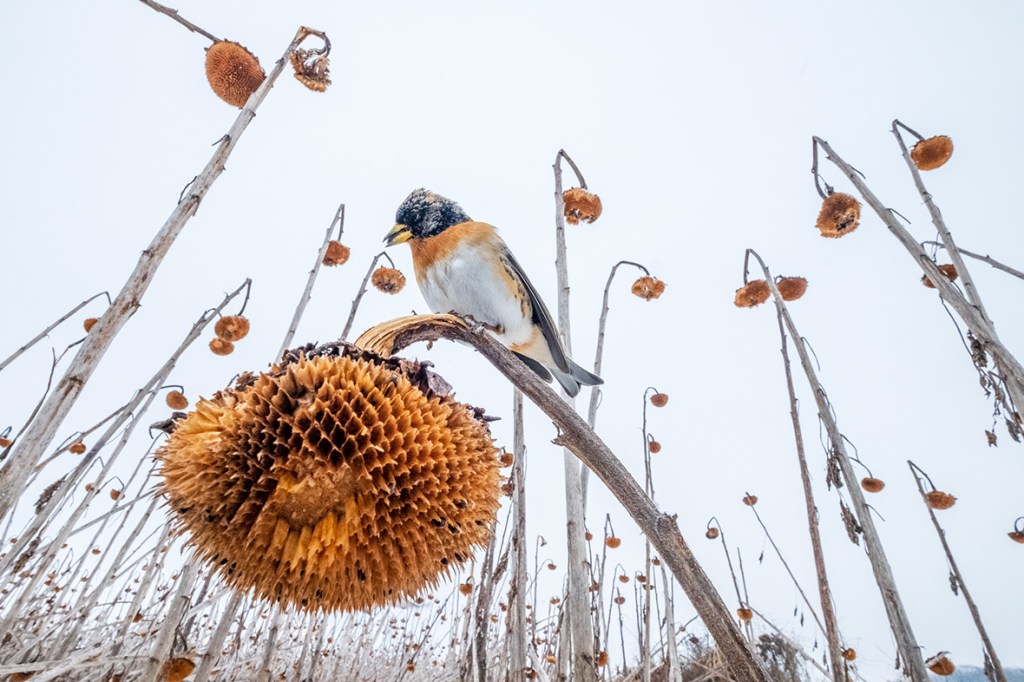
A picture by wildlife photographer Mateusz Piesiak showed a brambling in a sunflower field. Here’s the accompanying text:
At first glance, their orange PLUMAGE might seem to make them an easy target for falcons and hawks. But when the birds FORAGE on a field like this, they’re invisible to predators.
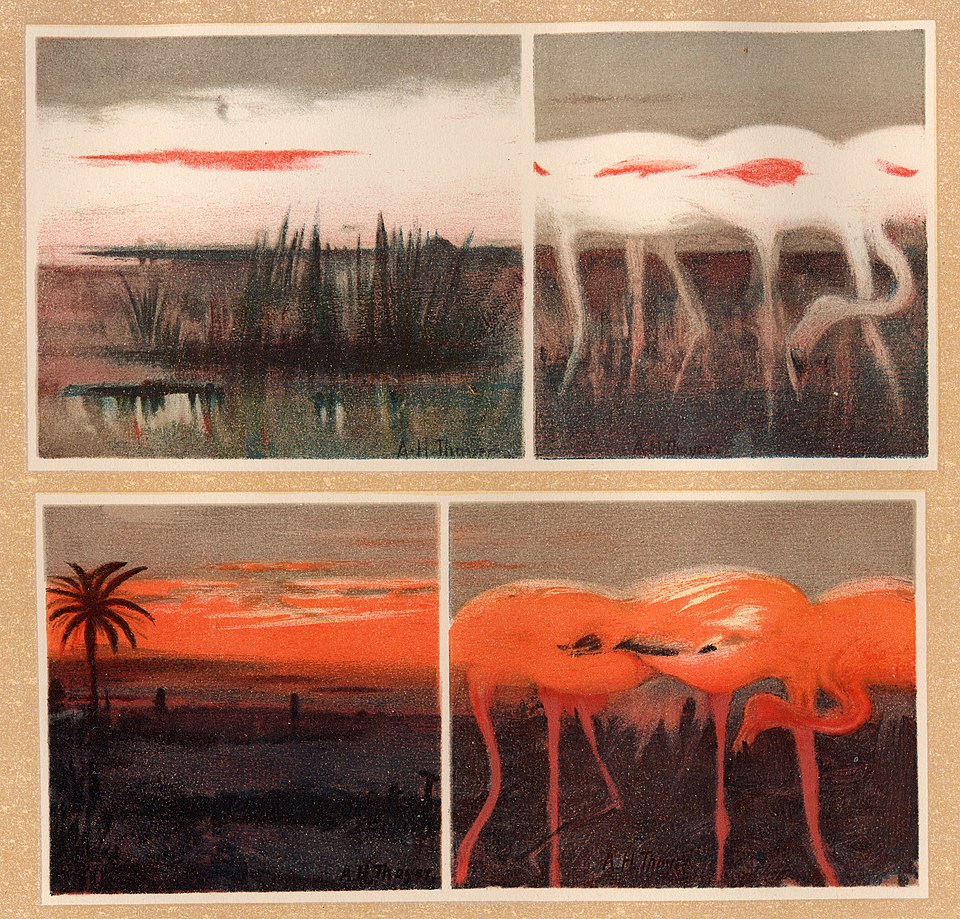
The capitalization of random words isn’t the only thing that’s wrong with this statement. It’s also wrong that the birds’ coloration is for camouflage. This is exactly the same mistake that painter and naturalist Abbott Thayer made more than a century ago, when he stated that flamingos are pink to camouflage themselves against the sunset. For this, he was eviscerated by President Theodore Roosevelt, who judged the matter important enough to take off preparing for the presidential primaries to write a lengthy and well-researched rebuttal:
Among all the wild absurdities to which Mr. Thayer has committed himself, probably the wildest is his theory that flamingoes are concealingly colored because their foes mistake them for sunsets […] As with so many of Mr. Thayer’s theories, there is a certain difficulty in meeting this, merely because of the fact that it is utterly absurd. It is difficult to meet a statement of what is against the evidence of the senses by an appeal to the senses; there is absolutely no use in arguing with a man whose mind is such that he is capable of making such a statement […] these suppositions represent nothing but pure guesswork, and even to call them guesswork is a little over-conservative, for they come nearer to the obscure mental processes which are responsible for dreams.
The underlying assumption that everything in nature is adaptive is incorrect. While the pictures of Piesiak’s brambling and Thayer’s flamingos are beautiful, they show the birds in contexts and from angles that are unlikely to be seen by any predator. Sexual selection is a superior explanation for the brambling’s coloration.
Roosevelt’s entertaining and savage dismissal of Thayer was the topic of Stephen Jay Gould’s 1991 essay Red Wings in the Sunset, published in his collection Bully for Brontosaurus. It’s unfortunate that despite Gould’s and Roosevelt’s prominence and eloquence, the same mistake that Thayer made more than a hundred years ago still gets repeated today.
 Nehaveigur
