I’ve recently started reading up on cuneiform a little. Last week, I had the opportunity to visit the Mesopotamian collection at the British Museum, which has the largest collection of cuneiform tablets in the world. Their exhibit on how Proto-cuneiform evolved from a simple accounting system is excellent.
Another exhibit shows cylinder seals. This one drew my attention:
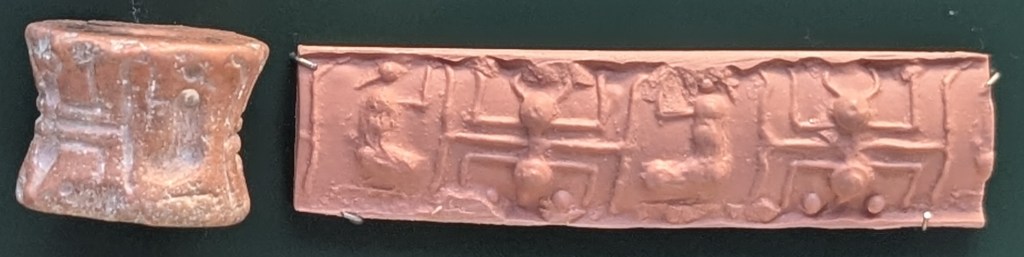
This is the corresponding label:
Calcite cylinder seal
Seated women alternate with spiders, which are probably symbols of Uttu, goddess of weaving. About 3000 BC (Jemdet Nasr period). Provenance unknown
I am certain that the characterization of the animals as spiders is wrong. Nobody who has observed a spider would draw it that way, even if their minds are as different from ours as the ancient Mesopotamians’ must have been. Unlike spiders, the depicted animals have segmented bodies and six legs. They look a lot like insects. If I had to make a call, I’d say they were meant to be ants. This makes it likely that the woman on the seal isn’t the goddess Uttu either.
Archeologists often assign interpretations to ancient images that I find hard to follow. I used to assume that the confidence with which they make such assignments means they’re likely to be correct. In this particular case, they’re wrong, which makes me wonder about their other interpretations too.
Here is a mischaracterization I’ve noticed in another museum.

