When the Euro was introduced on January 1st, 1999, it bought 1.17 US Dollars. More than 27 years and several economic crises later, you get 1.15 USD for one Euro. This is not what one would’ve predicted for two diverging economies whose central banks have different inflation targeting philosophies. Instead, I’d have predicted that differential inflation compounds over almost three decades, leading to vastly different exchange rates.
The Canadian dollar (CAD) goes back to 1858, when it was introduced at parity with the US dollar. Since then, it has stayed in a relatively narrow band, reaching its all-time low of 0.62 USD in 2002 and its all-time high of 1.10 USD in 2007. Today, one CAD buys 0.72 USD. Why has it not diverged more in the last 168 years? For some periods, like during World War II, the CAD was pegged to the USD, but there has been plenty of time to diverge before and after. If the CAD had weakened 1% each year since 1858, it’d stand at 0.19 USD now. If it had strengthened by 1%, it’d be at 5.30 USD now. Why has this not happened?
More realistically, how would we expect the final CAD-USD exchange rate to diverge 1858-2026 if it followed a random path? I asked Claude to simulate this over 1,000 iterations, with the annual divergence sampled from the empirically observed 1858-2026 distribution. Those random walks indicate that in most cases, the resulting absolute divergence is higher than the observed divergence (0.28).
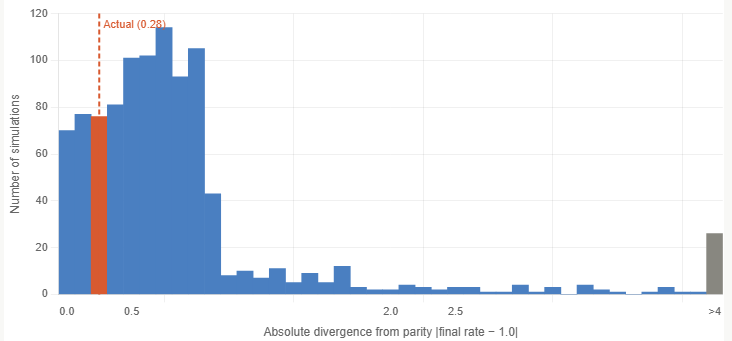
ChatGPT suggested that tight economic coupling as the explanation, but this sounds more like a post-hoc rationalization. After all, the Eurozone and the US economies aren’t that interdependent. Another explanation could be that the Bank of Canada and the European Central Bank attempt to keep the exchange rate from diverging too much. But why would they? This is a reasonable explanation over a time scale of years, but not over several decades. I cannot offer any satisfying explanation either, but I do believe that this phenomenon is something that needs explaining.

