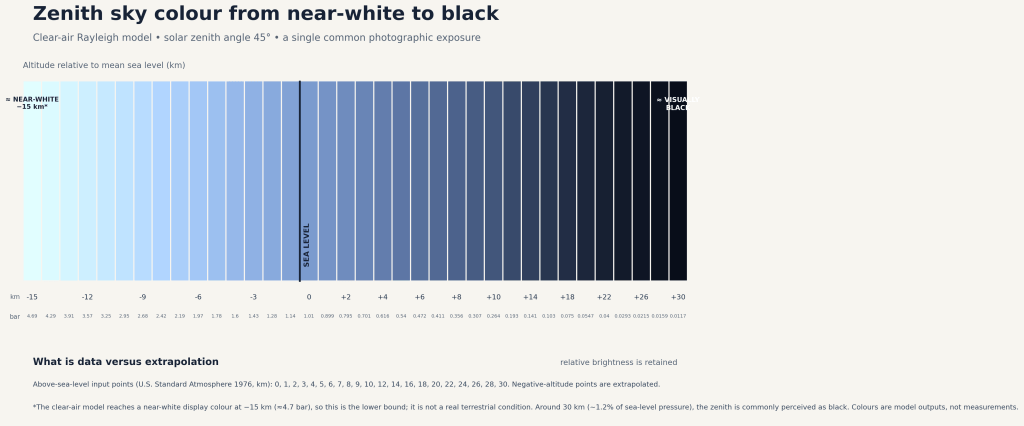
When Alexander von Humboldt was traveling South America and climbing its mountains around 1800, he carried an instrument for measuring the blueness of the sky. This cyanometer showed different gradations of blue that the sky could be compared to.
The closer to space, the darker the sky. On top of Mt Everest, the sky is a noticeably darker shade of blue than at sea level. Once you’re in space, it’s black. This made me wonder how the sky would appear when seen from below sea level. For example, the Mponeng mine in South Africa reaches four kilometers below sea level. I don’t know if there’s a mine shaft that reaches straight up all so that the sky could be seen from down there, but it seems unlikely. But if this were possible, what would it look like?
I had ChatGPT generate a cyanometer that shows the entire spectrum from white, to sea-level blue, to black, and link each gradation with the corresponding altitude, either above or below sea level. Turns out, at minus 4 kilometers, while the atmosphere would be significantly denser at 1.6 bar, the sky wouldn’t be much paler.